
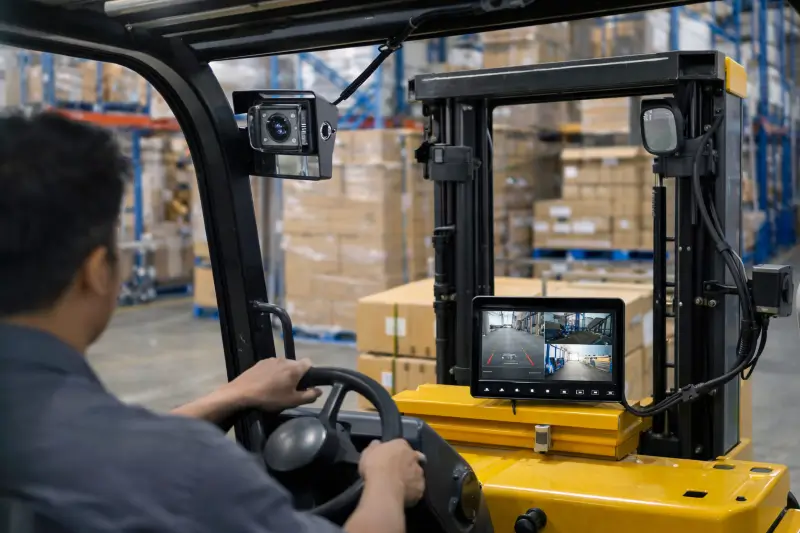
Forklift Camera System Buyer Guide for Warehouse Safety Managers, Fleet Operators, and Industrial Equipment Distributors
Introduction: Choosing the Right Forklift Camera System Is More Than Choosing a Camera
When companies decide to install a forklift camera system, the first question is usually:
Should we choose a wireless forklift camera or a wired forklift camera system?
The answer depends on your working environment, forklift type, installation requirements, and long-term maintenance expectations.
A wireless system can provide faster installation and more flexibility, while a wired system may offer a more traditional and stable connection for specific applications.
There is no single solution that fits every warehouse.
The right choice depends on where the forklift operates, how often it moves, and what safety problem you want to solve.
Quick Answer: Wireless vs Wired Forklift Camera System
| Wireless Forklift Camera | Wired Forklift Camera | |
|---|---|---|
| Installation | Faster, less modification | Requires cable routing |
| Installation cost | Usually lower | Usually higher |
| Maintenance | Easier replacement | Cable inspection needed |
| Suitable for | Multiple forklifts, rental fleets, changing environments | Fixed installations, harsh RF environments |
| Flexibility | Excellent | Limited |
| Signal stability | Depends on environment | Very stable connection |
For most warehouses that need quick installation across multiple forklifts, a wireless forklift camera system is usually the more flexible choice.
However, wired systems can still be the better option when the forklift works in environments with heavy wireless interference or permanent installation requirements.
1. When Should You Choose a Wireless Forklift Camera System?
A wireless forklift camera system is designed for companies that need:
- Faster installation
- Less downtime
- Flexible equipment movement
- Easy replacement between forklifts
- Lower installation complexity
Typical applications:
Large warehouses with multiple forklifts
Many logistics companies operate dozens or hundreds of forklifts.
A wireless solution allows technicians to install cameras without running long cables through:
- Mast sections
- Hydraulic systems
- Moving joints
- Protective covers
This reduces installation time and avoids cable damage caused by constant forklift movement.
Rental forklift fleets
Rental companies often need flexible solutions because equipment changes frequently.
A wireless forklift camera can be moved between machines without major modification.
This is especially useful for:
- Short-term projects
- Seasonal warehouse operations
- Construction equipment rental
Forklift applications requiring fork visibility
Many forklift accidents happen because operators cannot clearly see:
- Fork tips
- Pallets
- High-level racks
- Blind corners
A wireless fork camera installed near the forks can provide a clearer working view without complicated wiring.
2. When Should You Choose a Wired Forklift Camera System?
A wired forklift camera system is suitable when maximum connection reliability is the highest priority.
Typical situations include:
Heavy wireless interference environments
Some industrial locations contain many wireless devices:
- Large automated warehouses
- Factories with strong RF equipment
- Facilities with strict wireless restrictions
In these cases, a wired connection may provide a more predictable video signal.
Permanent forklift installation
If a company owns a fixed fleet and does not frequently change equipment, wired installation can be a practical option.
Examples:
- Dedicated production line forklifts
- Fixed warehouse operations
- Long-term industrial projects
3. How Does the Warehouse Environment Affect Your Choice?
The working environment is one of the most important factors when selecting a forklift camera system.
Environment 1: Standard Warehouse With Open Areas
Example:
- Distribution centers
- Storage warehouses
- Loading areas
Recommended:
✅ Wireless forklift camera system
Reasons:
- Easy installation
- Good signal conditions
- Faster deployment across multiple forklifts
Environment 2: Warehouse With High Metal Racks
Example:
- Cold storage
- High-bay warehouses
- Narrow aisle warehouses
Main concern:
Will metal racks affect wireless signal performance?
The answer depends on:
- Warehouse layout
- Distance
- Rack density
- Antenna position
A professional wireless system should be tested based on the actual site conditions.
Solutions may include:
- Optimized antenna placement
- Higher gain antennas
- Proper monitor installation position
Environment 3: Outdoor Material Handling
Example:
- Ports
- Construction yards
- Mining areas
- Agricultural operations
Important factors:
- Weather protection
- Vibration resistance
- Longer transmission distance
The camera system should support:
- IP69K protection
- Wide temperature operation
- Strong vibration resistance
4. What Features Matter When Buying a Forklift Camera System?
Many buyers focus only on camera resolution.
However, resolution is only one part of a reliable forklift safety solution.
A professional buyer should check:
1. Wireless Range Under Real Working Conditions
Manufacturers often advertise maximum open-field distance.
But warehouse environments are different.
Ask:
- What is the effective range inside a warehouse?
- How does the system perform behind racks?
- Is a high-gain antenna available?
2. Vibration Resistance
Forklifts operate in demanding environments.
The camera should handle:
- Continuous vibration
- Shock
- Dust
- Temperature changes
3. Camera Position Options
Different applications require different camera locations:
Fork-tip camera
Best for:
- Pallet positioning
- High racks
- Precise loading operations
Rear camera
Best for:
- Reverse safety
- Blind spot reduction
Mast camera
Best for:
- Forward visibility
- Operator assistance
4. Future Expansion Capability
A good forklift camera system should allow future upgrades.
For example:
- Additional cameras
- Recording function
- AI detection
- Multi-screen viewing
This avoids replacing the entire system later.
5. Common Mistakes When Selecting a Forklift Camera System
Mistake 1: Choosing Only Based on Price
The cheapest camera system may create problems later:
- Poor signal stability
- Short service life
- Difficult after-sales support
For industrial applications, reliability usually matters more than the initial purchase price.
Mistake 2: Ignoring Installation Conditions
A system that works well in an open warehouse may perform differently in:
- Cold storage
- Steel rack warehouses
- Large factories
Always evaluate the real application environment.
Mistake 3: Buying Consumer Backup Cameras for Industrial Use
Automotive backup cameras are not designed for:
- Continuous forklift operation
- Heavy vibration
- Industrial environments
Forklift applications require industrial-grade components.
6. How Forsafe Approaches Forklift Camera System Selection
At Forsafe, we believe the right forklift safety solution starts with understanding the working environment first.
We provide both:
Wireless Forklift Camera Systems
Designed for:
- Fast installation
- Forklift fleets
- Warehouse operations
- Rental equipment
Features include:
- Digital wireless transmission
- Multi-camera support
- Fork-view camera options
- IP69K industrial cameras
- Optional recording functions
Wired Forklift Camera Systems
Designed for:
- Stable connection requirements
- Permanent installations
- Heavy-duty applications
Features include:
- Reliable video transmission
- Industrial camera design
- Multiple camera positions
For customers who need more advanced safety protection, Forsafe also provides:
- AI forklift pedestrian detection solutions
- Forklift BSD systems
- MDVR recording solutions
This allows companies to start with a basic camera system and upgrade to a complete forklift safety solution when needed.
Forklift Camera System Buying Checklist
Before placing an order, ask these questions:
✅ What type of forklift will use the system?
✅ Indoor or outdoor application?
✅ How large is the working area?
✅ Are there metal racks or wireless interference?
✅ Do you need fork visibility?
✅ Do you need recording?
✅ Will you add AI safety functions later?
✅ Is the supplier able to provide technical support?
FAQ: Forklift Camera System Selection
Should I choose a wireless or wired forklift camera system?
For most warehouses requiring flexible installation and multiple forklifts, wireless systems are usually the better choice. Wired systems are suitable for fixed installations where maximum connection stability is required.
Can wireless forklift cameras work in warehouses with metal racks?
Yes, but performance depends on warehouse layout, distance, and installation position. A proper antenna design and site evaluation are important.
How many cameras does a forklift need?
It depends on the safety problem. Many forklifts use one fork camera, while larger machines may require multiple cameras for front, rear, and side visibility.
Are forklift cameras enough for warehouse safety?
A camera system helps reduce blind spots and improve operator visibility, but it should work together with proper training, traffic management, and safety procedures.
Can forklift camera systems support AI detection?
Yes. Advanced systems can integrate AI functions such as pedestrian detection, blind spot alerts, and event recording.
Final Recommendation
Choosing a forklift camera system is not simply a choice between wireless and wired technology.
The best solution depends on:
- Warehouse environment
- Forklift operation type
- Installation requirements
- Future safety goals
For flexible warehouse operations, wireless forklift camera systems provide easier installation and scalability.
For fixed industrial applications requiring maximum stability, wired systems remain a reliable option.
A professional supplier should help you select the right solution based on your actual working conditions — not simply sell a standard product.
Need help choosing the right forklift camera solution for your application?
Contact Forsafe for a recommended system configuration based on your forklift type and working environment.